
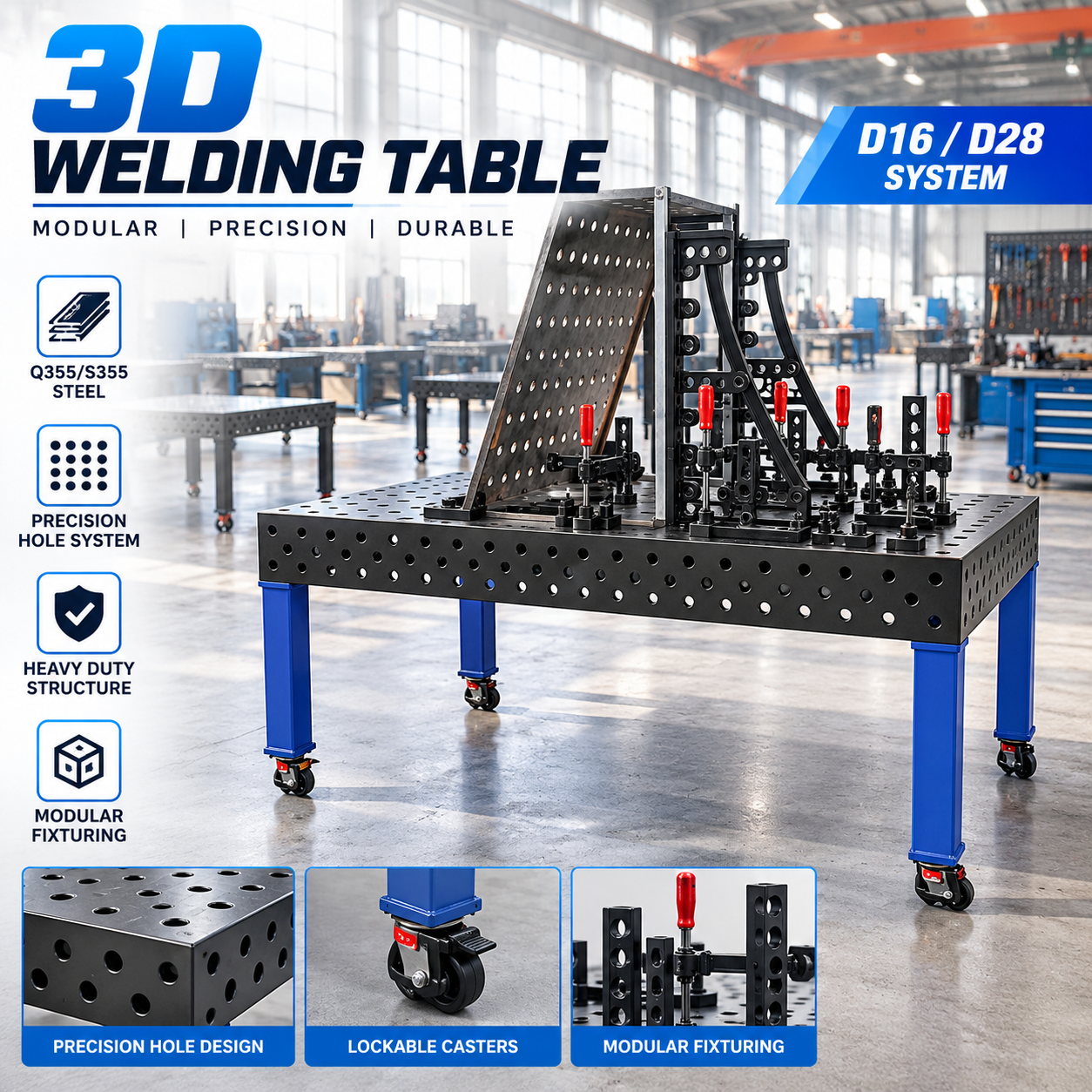
If you’re looking for a 3D welding table, you’ll probably find a lot of tables that look very similar.
Same size. Same hole system. Nitrided surface. CNC machined.
And then the prices can be very different.
We see this quite often when customers send us another quotation and ask, “Why is this one cheaper?”
Sometimes there is a good reason. Sometimes you’re simply comparing two tables that aren’t actually the same.
So before looking only at the final price, these are a few things worth checking.
1. What steel is being used?
This is an easy one to ask, but it’s often missed.
We normally use Q355/S355 steel for our 3D welding tables.
Also check the thickness of the working surface and how the table is reinforced underneath. A 2000 × 1000 mm D28 table isn’t automatically the same as another 2000 × 1000 mm D28 table.
From a photo, they may look almost identical.
Once you start checking the material and construction, the differences become easier to see.
2. Take a closer look at the holes
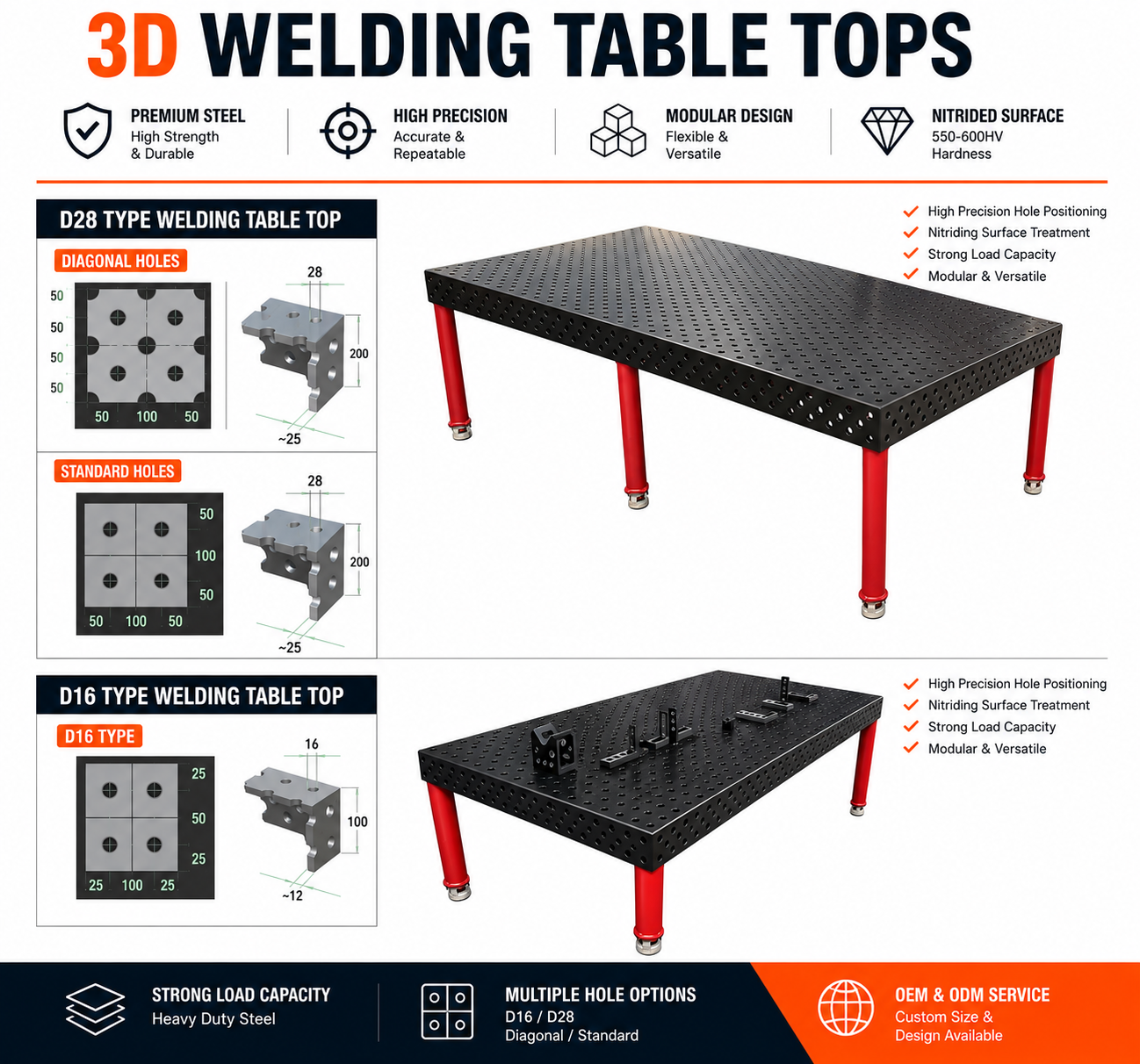
For a modular welding table, the holes get used all the time.
So the holes need to be consistent.
For example, our standard D28 system uses Ø28 mm holes with a 100 × 100 mm grid, while D16 uses Ø16 mm holes with a 50 × 50 mm grid.
But don’t just ask for the diameter and spacing.
Ask about the machining as well.
A very simple test is to try the same fixture in different holes around the table. It shouldn’t fit nicely in one hole and feel completely different in another.
That becomes annoying very quickly in daily use.
3. Flatness — ask for a number
For our standard welding tables, the flatness is controlled to ±0.1 mm/m².
If a customer needs it, we can also provide an inspection report.
This isn’t the most exciting specification on a welding table, but it’s an important one. You’re using the table as your reference surface when setting up the workpiece.
So it’s worth asking.
4. “Nitrided” doesn’t tell you everything
A lot of welding tables are advertised as nitrided now.
That’s fine, but we would still ask about the surface hardness and nitriding depth.
For our nitrided tables, we normally work with a surface hardness of around 550–600 HV and a nitriding layer depth of around 0.3–0.5 mm.
The reason is pretty straightforward.
This is a workshop table. People are going to clamp parts to it, slide things across it, remove fixtures and set everything up again.
It isn’t going to spend its life looking clean in a catalogue photo.
So the surface treatment should be suitable for that kind of use.
5. You probably don’t need every fixture in the catalogue
We sell welding fixtures too, so maybe this sounds a little strange coming from us.
But buying more fixtures isn’t always better.
What matters is whether you’ll actually use them.
If you’re making frames every day, your fixture setup might be quite simple. If you’re working with different parts every week, you’ll probably want more flexibility.
That’s why when someone asks us, “Which fixture set should I buy?”, it’s often easier if they send us a drawing or a few photos of what they’re making.
Then we can see what makes sense.
There’s no point shipping a big box of accessories that will sit in the corner of the workshop.
So, Which Table Should You Buy?
There isn’t really one answer.
A D16 table can be perfect for one workshop and completely wrong for another. The same goes for D28.
The table size, workpiece weight, type of welding and the way you normally set up your jobs all matter.
If you’re comparing quotations, don’t compare the price first.
Check the steel, thickness, hole system, flatness, surface treatment and fixtures. Then look at the price again.
You’ll have a much better idea of what you’re actually paying for.
And if you’re not sure what size or fixture combination you need, just send us a drawing or a photo of the parts you’re welding.
We’ve looked at plenty of unusual jobs over the years.
Bocheng Co-creation
3D Welding Tables | D16 & D28 Fixturing Systems
www.bcmeasuringtool.com
info@bcmeasuringtool.com
Post time: Sep-07-2026