
D16 or D28? We get asked this quite often.
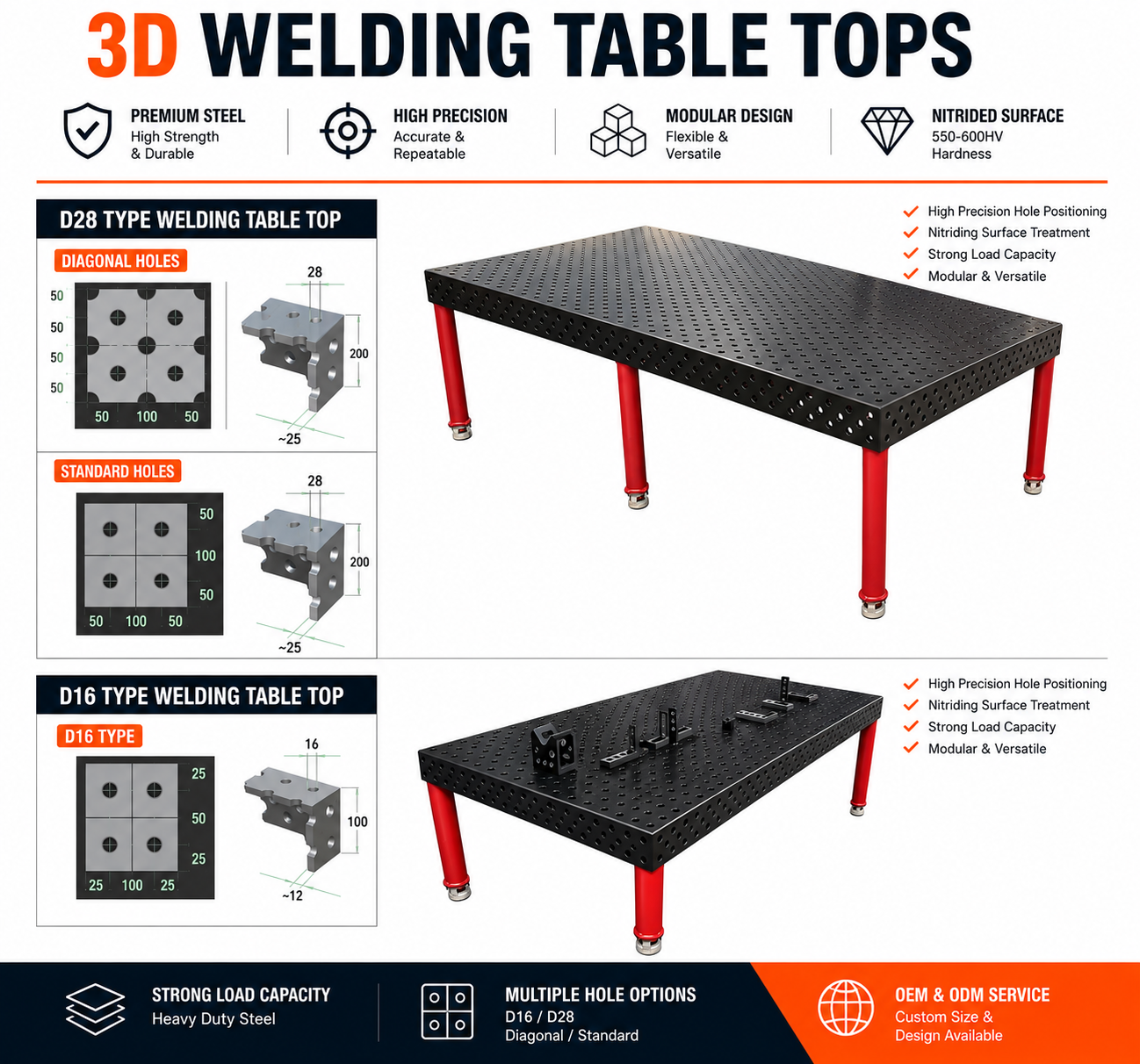
The obvious difference is the hole size. D16 tables use 16 mm holes, while D28 tables use 28 mm holes. But when we recommend a table to a customer, hole size is usually not the first thing we look at.
We normally ask what they are welding.
If the parts are relatively small — brackets, small frames, sheet metal parts or stainless steel assemblies, for example — D16 is often enough. The standard 50 × 50 mm hole pattern gives more positions for clamps and stops, and the fixtures are smaller and lighter.
For general light fabrication, it is a very practical system.
D28 is more commonly used when the work starts getting heavier. The standard hole pattern is 100 × 100 mm and the clamps, bolts, stops and angle brackets are all larger.
We see D28 used a lot for machine frames, large steel structures, heavy fabrication and production welding. It is also commonly used together with robotic welding systems.
So if a customer tells us they are welding a large steel frame, we will normally look at D28 first. If they are making smaller parts and need more flexible positioning, D16 may be the better choice.
But there are exceptions.
Table size alone doesn’t tell us which system you need. You can have a large D16 table for relatively small components, or a smaller D28 table for heavy parts.
That’s why we usually don’t recommend a system based only on a table size such as 1200 × 2400 mm or 1500 × 3000 mm.
The fixtures also need to be considered.
A welding table is useful because you can change the setup. Clamps, stops, locating pins and angle brackets can be moved around depending on the job. If the next part is different, you change the fixture arrangement rather than making a completely new fixture.
This applies to both D16 and D28.
For reference, the basic differences are:
| | D16 | D28 |
| ————- | ———————- | ———————- |
| Hole size | Ø16 mm | Ø28 mm |
| Standard grid | 50 × 50 mm | 100 × 100 mm |
| Fixtures | Smaller, lighter | Larger, heavier |
| Common use | Small and medium parts | Medium and large parts |
There are other things we would also check when buying a welding table: table flatness, hole machining, material, surface treatment and the fixture quality.
For our D16 and D28 welding tables, we mainly use Q355 steel. Nitrided versions are available, with a typical surface hardness of 550–600 HV. We also manufacture the matching clamps, stops, locating pins, angle brackets and other welding table accessories.
If you’re deciding between D16 and D28, you can send us a drawing or even just a photo of the parts you normally weld, together with the approximate dimensions and weight.
We can then recommend the system based on the actual job rather than simply telling you that D16 or D28 is “better.”
Post time: Aug-27-2026