
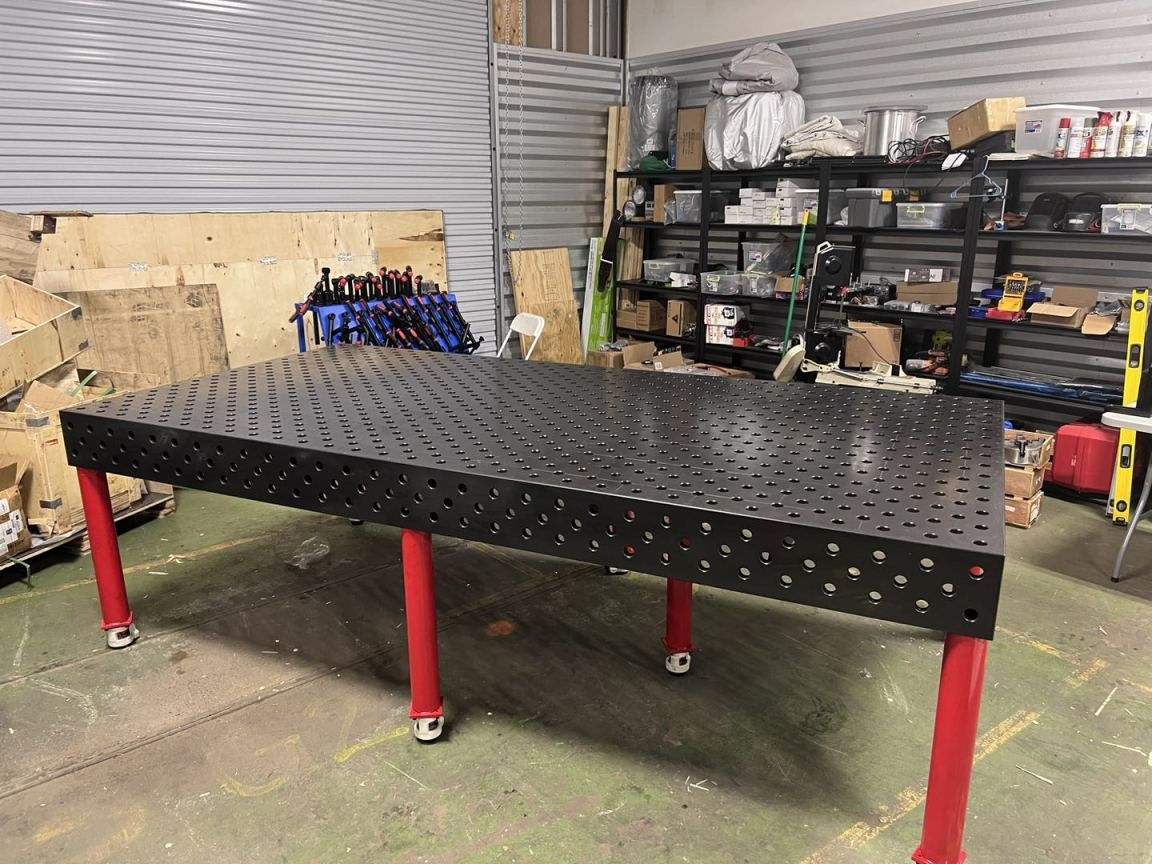
 A customer once asked us a very simple question: “Do I really need nitriding?”
It’s a fair question.
When you’re comparing welding tables, you see a lot of specifications — steel grade, plate thickness, hole size, hardness, flatness, nitriding depth… After a while, everything starts to sound important.
But if we’re talking about nitriding, we don’t think it needs to be complicated.
A welding table gets used hard.
Parts are put on it, moved around and taken off again. Clamps are fitted and removed constantly. There is welding spatter, grinding dust and all the usual mess that comes with fabrication work.
If this happens every day, the surface is going to take some wear.
That’s the main reason we use nitriding.
On our tables, the surface hardness after nitriding is usually around 550–600 HV, with a nitrided layer of around 0.3–0.5 mm.
Those are the numbers we put on a specification sheet. But in the workshop, what matters is much simpler: the surface is harder, it handles wear better, and it’s easier to clean after welding.
That’s really the point.
We should also say that nitriding isn’t some magic treatment.
Welding spatter can still stick. The table can still be scratched if it’s abused. And a nitrided table isn’t automatically a good welding table.
Actually, if we were checking a table, nitriding wouldn’t be the first thing we’d look at.
We’d check the flatness first.
Then the holes.
We’d look at how the table is made underneath, because you can have a very nice-looking top surface and still have a poor structure below it.
We’d also want to know what material was used.
For our standard tables, we normally use Q355/S355 steel, with CNC-machined working surfaces and holes. Standard flatness is around ±0.1 mm/m².
Get those things right first. Then nitriding makes sense.
It protects a surface that was already made properly.
We make both D16 and D28 welding tables, and customers sometimes ask us which one is better. We usually ask them what they’re making before answering.
It’s the same with nitriding.
A small workshop using the table a few times a month has different needs from a fabrication shop putting parts on the table every day.
So we wouldn’t say every customer must buy a nitrided welding table.
But if we were choosing a table for our own workshop and knew it was going to be used every day?
Yes, we’d choose nitriding.
Not because 550–600 HV looks good in a brochure.
Because after a few years of clamping, welding and cleaning, that’s when you start to appreciate why the surface treatment was there in the first place.
At Bocheng Co-creation, we manufacture D16 and D28 welding tables and fixturing systems. If you’re choosing a table and aren’t sure what specifications you actually need, send us the parts you’re working with. It’s usually much easier to recommend a table once we know what you’re going to make.
Post time: Sep-03-2026